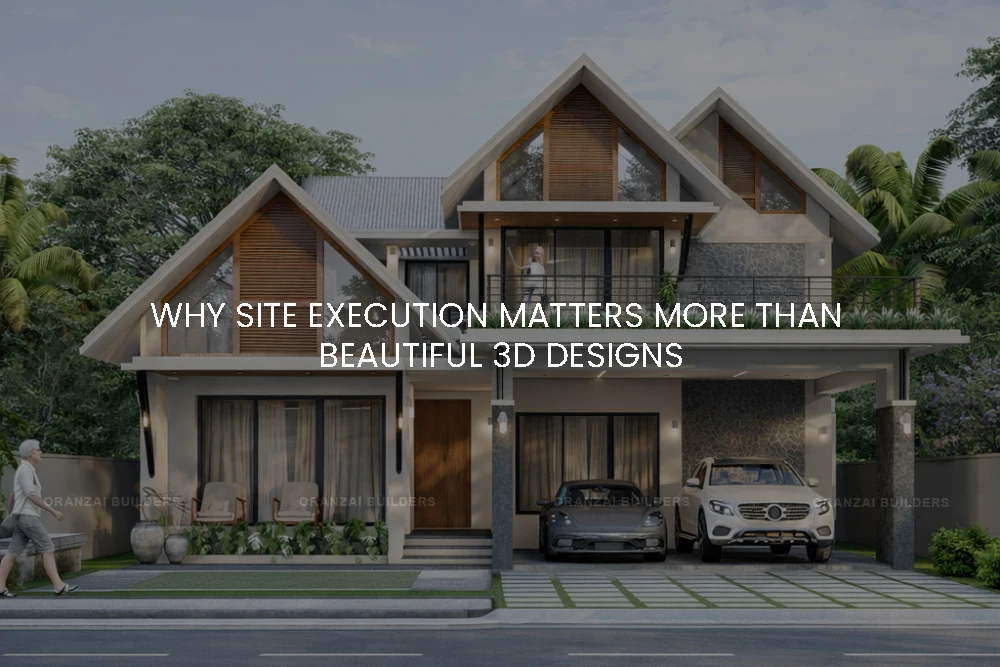
For many homeowners planning a new house, the journey often starts with 3D designs. Clean lines, perfect lighting, stylish interiors, and flawless finishes shown on a screen can be very convincing. These visuals help people imagine their future home and feel confident about moving forward.
But after decades of hands-on experience in residential architecture and turnkey construction, one truth remains constant. A house is not built in software. It is built on site, through people, processes, coordination, and discipline. No matter how refined a 3D design looks, the final outcome depends almost entirely on how well it is executed on the ground.
This is where many projects succeed or fail.
What 3D Designs Are Meant to Do, and What They Are Not
3D designs play an important role. They help homeowners understand spatial relationships, proportions, and overall intent. They are tools for alignment and discussion, not guarantees of outcome.
A 3D image does not account for:
• Site conditions and access limitations
• Real construction tolerances
• Material behavior during installation
• Coordination between trades
• Human workmanship and sequencing
When expectations are built only on visuals, the gap between design and reality can become a source of disappointment. Execution is what bridges that gap.
The Site Is Where Design Meets Reality
Every construction site introduces variables that no rendering can fully capture.
Ground levels vary. Walls are built by human hands. Concrete behaves differently depending on weather. Materials arrive in batches, not pixels. Services like plumbing, electrical, and air conditioning must pass through structural and architectural elements without conflict.
Strong site execution means:
• Understanding design intent clearly
• Translating drawings into buildable details
• Managing tolerances without compromising quality
• Making informed decisions when conditions change
Without this, even the best designs lose their value.
Precision on Paper Does Not Equal Precision on Site
Design software allows millimetre-level precision. Construction does not.
Walls have thickness variations. Plaster adds layers. Tiles have joint gaps. Furniture requires clearance. Services need space to run and be serviced later.
Experienced site teams understand where flexibility is required and where accuracy is non-negotiable. They know which elements must be aligned perfectly and which can absorb small adjustments without affecting the final result.
This judgment comes only from execution experience, not from visual design skill alone.
Coordination Is the Hidden Backbone of Good Execution
A home is built by many hands. Structural teams, masonry workers, electricians, plumbers, carpenters, painters, and installers all contribute at different stages.
When coordination is weak, problems appear quickly:
• Electrical points clash with furniture
• Plumbing lines interfere with structural elements
• Ceiling designs block access to services
• Finishes are damaged during later work
In turnkey construction, site execution succeeds when one team controls sequencing, communication, and accountability. This prevents rework and ensures that design intent survives the construction process.
Materials Only Perform Well When Installed Correctly
A premium material installed poorly will fail faster than a standard material installed properly.
Tile alignment, waterproofing layers, joint treatment, surface preparation, curing time, and fixing methods all matter. These steps are invisible once the house is complete, but they decide durability and finish quality.
3D designs do not show:
• Sub-surface preparation
• Adhesive thickness and curing
• Waterproofing overlaps
• Fixing tolerances
Site execution determines whether materials last or deteriorate early.
The Role of Supervision Cannot Be Overstated
Good execution requires constant supervision, not occasional site visits.
Daily monitoring ensures:
• Drawings are interpreted correctly
• Workmanship standards are maintained
• Errors are corrected before they become permanent
• Quality checks happen at each stage
Without supervision, small deviations accumulate. By the time finishes are installed, corrections become expensive or impossible.
A visually impressive design cannot compensate for poor supervision on site.
When Design Changes Meet Execution Reality
Almost every house project experiences some level of change during construction. Site conditions, practical constraints, or homeowner decisions can require adjustments.
Strong execution teams handle this calmly and responsibly. They assess impact on structure, services, budget, and timeline before implementing changes. Weak teams make quick fixes that solve one issue and create several new ones.
The difference lies in experience and accountability, not in design presentation.
Why Turnkey Execution Protects Design Intent
In fragmented projects, designers hand over drawings and walk away. Contractors focus on building, often without full design context. Interiors are executed separately, leading to misalignment.
In a turnkey model, design and execution are part of the same responsibility. The team that creates the design is also responsible for delivering it on site.
This alignment ensures:
• Designs are realistic and buildable
• Details are developed with execution in mind
• Site decisions respect original intent
• Quality is owned, not transferred
Execution becomes an extension of design, not a compromise.
A Finished Home Is the Only Real Measure of Success
Homeowners do not live in drawings or 3D views. They live in spaces that must feel comfortable, durable, and complete.
What matters in the end is:
• Straight walls and clean finishes
• Doors that close smoothly
• Bathrooms that stay dry
• Kitchens that function daily
• Spaces that feel balanced and practical
These outcomes are shaped on site, day after day, not on a screen.
Conclusion: Designs Impress, Execution Endures
Beautiful 3D designs can inspire confidence, but they are only the starting point. The real quality of a home is determined by how well it is executed on site.
Strong site execution respects design, understands construction realities, and takes responsibility for outcomes. It turns intent into reality without excuses.
At Oranzai Builders, turnkey execution is built around this principle. Architecture, construction, and interiors are coordinated through one accountable team, ensuring that what is planned is what gets built.