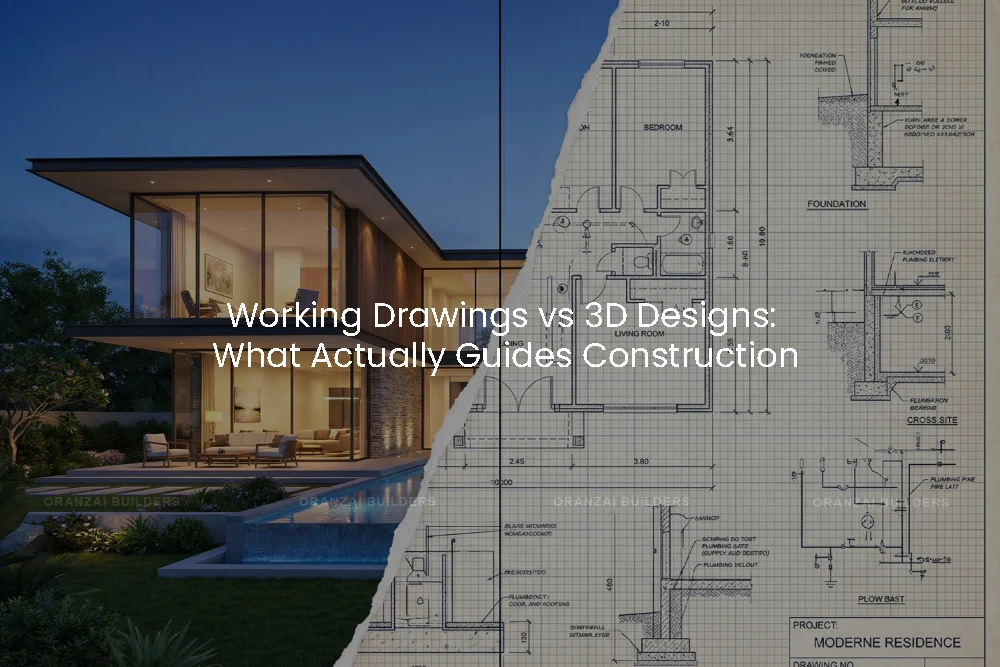
Working Drawings vs 3D Designs: What Actually Guides Construction
When homeowners begin planning a new house, the first thing that usually creates excitement is the 3D design. Clean elevations, soft lighting, well-styled interiors, everything looks complete and convincing.
At that stage, it is easy to feel like most of the work is already figured out.
But once construction begins, reality works very differently.
From years of handling residential architecture and turnkey construction, one thing becomes very clear.
3D designs help you visualise your home. Working drawings are what actually build it.
For property owners evaluating the Best Architect Company in Kerala, understanding this difference is essential. Because what gets executed on site is never based on visuals alone. It is built using precise, technical working drawings.
What a 3D Design Really Contributes
3D designs are an important part of the design process. They help homeowners understand the overall direction of the project.
A good 3D presentation gives clarity on:
• The overall look and feel of the house
• Proportions of spaces
• Exterior elevation style
• Interior design concepts
• Material tone and visual combinations
These visuals are especially useful during discussions. They reduce confusion and help align expectations between the homeowner and the design team.
But there is a clear limitation.
A 3D design is not a construction document.
It does not tell the site team how to execute the work. It only shows how the finished space should look.
What 3D Designs Do Not Show
This is where most misunderstandings happen.
A 3D image may look detailed, but it does not include technical instructions required for construction.
It does not define:
• Structural reinforcement details
• Exact beam and column sizing
• Plumbing slopes and pipe routing
• Electrical conduit paths
• Load-bearing calculations
In simple terms, it shows the outcome, not the process.
This is why relying only on 3D designs during construction leads to confusion on site.
What Working Drawings Actually Deliver
Working drawings are the backbone of construction.
They are detailed technical documents prepared specifically for execution. Every dimension, level, and alignment is defined clearly so that site teams can build without guesswork.
A complete set of working drawings typically includes:
• Dimensioned floor plans
• Structural drawings with beam and column details
• Foundation and footing layouts
• Electrical and plumbing layouts
• Section drawings showing levels and heights
• Staircase details
• Door and window schedules
• Ceiling and interior execution drawings
These drawings guide every activity on site. They ensure that each team knows exactly what to do, where to do it, and how to do it.
Without working drawings, construction becomes dependent on assumptions, and that is where problems begin.
Why 3D Designs Cannot Replace Working Drawings
A common mistake homeowners make is assuming that a detailed 3D design is enough for execution.
In reality, even the most visually rich design cannot replace technical documentation.
Take a simple example.
A 3D design may show a floating staircase. It looks clean and elegant.
But the working drawing defines:
• Exact riser and tread dimensions
• Structural reinforcement details
• Load transfer mechanism
• Anchorage points
Similarly, a 3D kitchen may look perfect visually. But the working drawing determines:
• Counter height and depth
• Electrical load points
• Plumbing connections
• Chimney duct routing
• Internal cabinet dimensions
Construction teams do not build based on appearance. They build based on measurements.
This is why experienced professionals, including those from the Best Construction Company in Kerala, prioritise working drawings before starting execution.
The Risks of Incomplete Working Drawings
When working drawings are not detailed or properly coordinated, issues start appearing during construction.
These issues include:
• Confusion on site
• Frequent changes during execution
• Structural and service clashes
• Electrical and plumbing rework
• Cost overruns
• Project delays
Even small errors can have a large impact. A minor deviation in the structural stage can become a visible alignment issue during interior finishing.
This is why documentation is not just a formality. It directly affects quality, cost, and timeline.
Protecting Design Through Technical Clarity
Interestingly, the only way to protect a beautiful design is through strong technical planning.
Without detailed working drawings:
• Ceiling levels may not align properly
• Beams may interfere with interior design
• Windows may not match furniture layouts
• Interior spaces may feel compromised
Working drawings translate design intent into exact instructions.
They ensure alignment between:
• Architecture
• Structure
• Services
• Interior design
For homeowners working with the Best Architect Company in Kerala, this integration is what ensures that the design seen during planning is delivered accurately during execution.
The Role of Site Execution and Supervision
Even with the best drawings, execution needs discipline.
On site, teams must continuously verify:
• Levels before slab casting
• Dimensions before masonry work
• Service routing before plastering
• Interior alignment before installations
Drawings guide the process. Site supervision ensures that the process is followed correctly.
When design and execution are handled within one system, responsibility is clear. There is no confusion between teams, and decisions are made with full context.
This structured approach is a key reason why homeowners prefer working with the Best Construction Company in Kerala for complete residential projects.
Why Turnkey Construction Depends on Strong Documentation
In modern homes, complexity has increased significantly.
Multiple levels, custom staircases, integrated lighting, layered ceilings, and advanced service systems all require precise coordination.
Without detailed working drawings, even experienced teams struggle to maintain consistency.
At Oranzai Builders, architecture, construction, and interior design are developed together. Working drawings are created not just for presentation, but for execution accuracy.
This is what separates organised turnkey construction from loosely managed projects.
A Simple Way to Look at It
Think of it in practical terms.
3D design shows you the vision.
Working drawings give you the instructions.
You cannot build a house by looking at an image, just like you cannot assemble a complex system without specifications.
A home may look simple in a rendering, but its execution involves hundreds of interconnected decisions.
What Homeowners Should Pay Attention To
If you are planning a new home, shift your focus slightly.
Instead of only asking how your home will look, also ask how it will be documented and executed.
Key things to understand include:
• Structural detailing approach
• MEP coordination process
• Interior execution drawings
• Revision and approval systems
• Site verification methods
Clarity in these areas ensures that your project runs smoothly from start to finish.
Conclusion: Construction Follows Precision, Not Just Presentation
3D designs create excitement. They help you imagine your future home clearly.
But construction does not follow visuals. It follows dimensions, levels, and technical instructions.
The success of a residential project depends on how well the design is translated into working drawings and how accurately those drawings are executed on site.
For homeowners choosing the Best Architect Company in Kerala, this technical clarity becomes a defining factor. Structured documentation, coordinated planning, and disciplined execution ensure that what is designed is what actually gets built.
If you are planning a new house and want to understand how your design will move from concept to construction with precision, a structured discussion with Oranzai Builders can help you move forward with confidence and complete clarity.