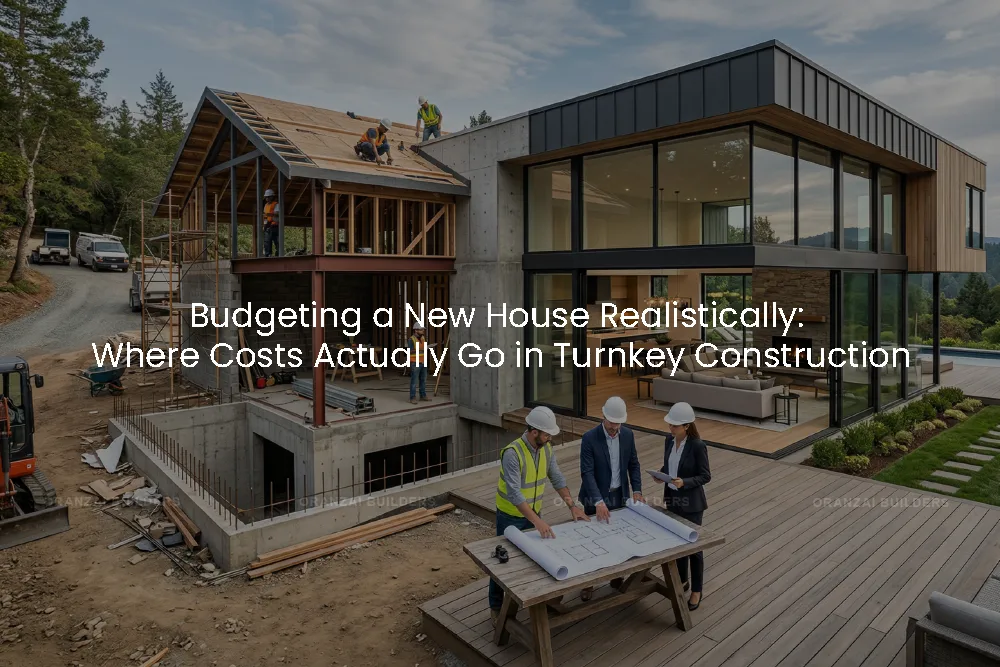
When property owners start planning a new house, the first serious question is almost always about cost. Not just the total number, but what that number actually includes. Many homeowners are surprised later when expenses rise, not because something went wrong on site, but because the budget was never understood clearly at the beginning.
At Oranzai Builders, we work on complete A–Z house construction and interior projects under a turnkey model. Over time, one thing has become very clear. A realistic budget is not about guessing a cost per square foot. It is about understanding where money is genuinely spent and why those costs exist.
This article breaks down how budgets work in turnkey construction and helps homeowners plan with clarity rather than assumptions.
Turnkey Budgeting Is About the Whole House, Not Isolated Parts
In turnkey construction, budgeting is done for the entire home as one integrated system. Architecture, construction, interiors, services, and execution are not treated as separate islands.
This matters because every design decision affects cost. Room sizes affect structure. Structure affects finishes. Finishes affect services. When budgeting is fragmented, costs feel unpredictable. When budgeting is integrated, costs become manageable and transparent.
A realistic budget looks at the house as it will be lived in, not just as it will be built.
Architecture and Planning Costs: The Foundation of Cost Control
Architectural planning is often underestimated in budgeting discussions. Some homeowners see it as a small percentage of the total cost and assume it has little impact. In reality, architecture controls almost every future expense.
Good planning determines:
Efficient room layouts
Structural logic that avoids overdesign
Correct orientation and openings
Practical ceiling heights and spans
When architecture is resolved early, unnecessary structural complexity is avoided. That alone can save significant cost during construction. In turnkey projects, architectural decisions are made with execution and budget in mind, not in isolation.
Structural Construction: Where a Major Share of the Budget Goes
The structural stage forms a large portion of the overall budget. This includes foundations, columns, beams, slabs, masonry, and roofing.
Costs here are influenced by:
Soil conditions and foundation type
Structural spans and load calculations
Number of floors and slab heights
Quality of materials and workmanship
One common mistake is trying to reduce cost by cutting corners at the structural level. This often leads to long-term issues and compromises interior planning later. In a turnkey approach, structure is designed to be safe, efficient, and aligned with the rest of the house, not overbuilt or underbuilt.
Services: Often Invisible, Always Essential
Electrical, plumbing, and mechanical services are rarely visible in finished homes, but they account for a meaningful part of the budget.
These costs include:
Wiring and distribution systems
Plumbing lines and drainage
Water storage and pumping systems
Provisions for air-conditioning and ventilation
Poor service planning results in surface-mounted lines, false ceilings added later, and frequent maintenance issues. When services are planned early as part of the architectural and interior design process, costs are controlled and performance improves.
Interior Construction and Finishes: Where Choices Matter Most
Home interiors are where homeowners feel the budget most directly. Flooring, kitchens, wardrobes, doors, bathrooms, and lighting all sit here.
Interior costs vary widely based on:
Material quality and durability
Level of detailing and finish
Custom work versus standard solutions
Integration with architecture
A realistic interior budget does not chase trends blindly. It prioritizes longevity, daily use, and maintenance. In turnkey construction, interior design is aligned with the overall budget from the beginning, reducing the risk of mid-project compromises.
Built-In Furniture and Storage Planning
Another area where budgets often drift is built-in furniture. Wardrobes, kitchen units, storage cabinets, and utility spaces are essential for daily living, yet they are sometimes treated as optional additions.
When these elements are planned late:
Costs rise due to rushed decisions
Spaces feel cluttered or inefficient
Structural provisions may be missing
Planning built-in furniture early allows for better cost control and cleaner execution. It also avoids temporary solutions that later need replacement.
Coordination, Execution, and Site Management Costs
In turnkey construction, a portion of the budget goes into coordination and on-site management. This is not an extra layer. It is what holds the project together.
These costs cover:
Project scheduling and supervision
Quality checks at every stage
Vendor and material coordination
On-site problem-solving and accountability
Without proper execution management, even good designs struggle. Single-point responsibility ensures that decisions are aligned and delays are minimized.
Contingency: Planning for the Inevitable
Even with good planning, some changes are inevitable. Material availability, minor design refinements, or client preferences can evolve.
A realistic budget always includes a contingency margin. This does not mean expecting problems. It means acknowledging that construction is a process with moving parts.
In turnkey projects, contingency is managed transparently, not as an afterthought.
Why Unrealistic Budgets Create Bigger Problems Later
Budgets fail when they are based on assumptions rather than scope. Starting with an unrealistically low budget often leads to:
Repeated design revisions
Downgrading materials mid-way
Incomplete interiors at handover
Stressful decision-making under pressure
A realistic budget may feel higher at first, but it prevents disappointment and compromise later.
How Turnkey Construction Brings Budget Clarity
The strength of turnkey construction lies in integration. When architecture, construction, interior design, and execution are handled by one team, budgeting becomes clearer.
At Oranzai Builders, budgets are developed alongside design decisions. This allows homeowners to see how choices affect cost and to adjust early, when changes are still easy.
This approach creates:
Final Thoughts
Budgeting a new house realistically is not about finding the cheapest number. It is about understanding where money is spent and why those expenses matter.
A well-planned turnkey budget covers architecture, structure, services, interiors, and execution as one connected system. When this clarity exists from the beginning, construction becomes smoother and outcomes improve significantly.
If you are a property owner planning a new house or villa and want a clearer understanding of how budgeting works in turnkey construction, an early consultation can help set the right expectations. At Oranzai Builders, we believe that informed planning is the first step toward a well-built home that lasts.